
The Rural Refactor: Social Structures & Conflict in 2026

In 2026, the countryside is the “source code” for global stability. Explore how Rural Sociology is debugging the conflicts over water rights, the social impact of “Livestock AI,” and the rise of climate-driven migration hubs. Learn why the “Rural Burden” is the next big challenge for corporate social responsibility.

At Iverson Software, we analyze complex systems. In Rural Sociology, the 2026 update is about the friction between “Long-Standing Tradition” and “Rapid Digital Transformation.” As non-urban areas integrate AI-driven machinery and face intensifying climate pressures, the social fabric is being pulled in two directions: toward global efficiency and local resilience.

1. The Digital Agrarian Divide: AI and Social Power

The most visible shift in 2026 is the emergence of Precision-Powered Class Structures.

  • The “Data Engine” Farm: As rural operations evolve into powerful data engines, a new social hierarchy is forming. Large-scale growers with the capital to invest in autonomous tractors and “Livestock AI” are pulling ahead, while smaller operations face a steep adoption curve.

  • Technological Dispossession: Rural sociologists are tracking “Technological Dispossession”—where the high cost of smart equipment and software subscriptions forces smaller farmers into “Shadow Labor” roles or causes them to exit the industry entirely.

2. Natural Resource Conflicts: The War for Senior Water Rights

As weather patterns shift in early 2026, the management of natural resources is triggering local “Micro-Conflicts.”

  • Water Sovereignty: In arid regions like the American Southwest, “Senior Water Rights” have become the new currency of power. Conflicts are erupting between traditional agriculturalists, expanding suburban developers, and indigenous communities over who controls the dwindling “Blue Gold.”

  • The Energy Burden: Rural communities are increasingly at the center of the “Renewable Transition.” Sociologists are documenting local opposition to utility-scale solar and wind developments—a phenomenon known as the “Rural Burden,” where rural landscapes are utilized for urban energy needs.

3. Rural Resilience & The “Quiet Crisis”

Beyond the headlines, rural areas are facing a demographic reshuffling that is redefining community life.

  • The Silver Tsunami in the Fields: Rural populations are aging rapidly. Sociologists are studying the “Care Gap”—the lack of healthcare and financial support for older adults in isolated areas.

  • Climate Havens: Parts of the Upper Midwest and Pacific Northwest are becoming “Newly Attractive” hubs for agriculture and migration due to moderate climates. This is creating a “Demographic Boom” that strains local infrastructure while offering a rare chance for community revitalization.

4. Justice in the Heartland: Advocating for the Unseen

The 2026 Rural Sociological Society theme, “Advocating for Justice,” highlights the move toward legal and social equity in the countryside.

  • Beyond the Law: Sociologists are partnering with legal scholars to tackle “Law-and-Society” issues in rural areas—from immigration and land-use disputes to the “Opioid Empathy Gap.”

  • Food & Energy Justice: The focus has shifted to “Just Transitions,” ensuring that the move to a green economy doesn’t leave rural labor behind.


Why Rural Trends Matter to Your Organization

  • Supply Chain Integrity: Understanding rural social conflicts is key to predicting disruptions in food and resource availability.

  • ESG and Rural Impact: Organizations must ensure their sustainability initiatives (like carbon offsets or renewable projects) don’t impose a “Rural Burden” on local communities.

  • Emerging Markets: The “Climate Haven” shift creates new opportunities for localized services, rural broadband infrastructure, and diversified income models for younger farmers.
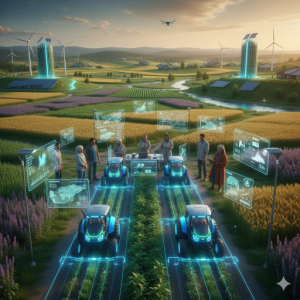
    The image provided for precision agriculture illustrates the integration of high-tech data collection and automation into modern farming.
    Sowing the Seeds of Data: Precision Agriculture in 2026

Planetary Feedback Loops: Societies, Environment, and Climate in 2026

In 2026, the planet is talking back. Explore how societies are “debugging” their relationship with the environment, from the urgency of climate migration to the wisdom of Indigenous knowledge. Learn why “Societal Resilience Audits” are now essential for every organization.

At Iverson Software, we specialize in system diagnostics. The relationship between human societies and their physical environment is, in 2026, a series of increasingly intense feedback loops. Our actions directly impact the planet, and the planet’s reactions are now directly impacting our social structures, economies, and very definitions of stability. This year’s focus is on “Societal Resilience Audits”—how well are we prepared for the inevitable, and how effectively can we adapt?

1. The Climate Migration Imperative: Shifting Populations

One of the most profound societal shifts of 2026 is the acceleration of Climate Migration.

  • Forced Displacement: Millions are being displaced by sea-level rise, desertification, and extreme weather events. Digital sociologists are mapping these “Climate Corridors,” observing the emergence of new social structures among displaced communities.

  • “Climate Havens” & Social Strain: The influx of climate migrants into historically stable regions (often in the Global North) is creating both opportunities for demographic revitalization and significant social and economic strain. New “Integration Protocols” are being developed to manage these population shifts.

2. Eco-Communities & Degrowth: Redefining “Progress”

A powerful counter-narrative to traditional industrial models is the rise of Eco-Communities and the philosophy of Degrowth.

  • The “Local Resilience Grid”: Around the world, communities are investing in hyper-local food systems, renewable micro-grids, and shared resource models. These are not just sustainable practices but a social statement, rejecting globalized consumption in favor of local self-sufficiency.

  • Degrowth as a Social Movement: The “Degrowth” movement, once fringe, is gaining academic and political traction. It posits that true sustainability requires a conscious reduction in resource consumption and a redefinition of “well-being” away from endless economic growth.

3. Indigenous Knowledge Integration: Ancient Wisdom, Modern Solutions

As Western science grapples with complex ecological crises, there is a profound resurgence of interest in Indigenous Knowledge Systems.

  • “Nature-Based Solutions”: Governments and NGOs are actively partnering with Indigenous communities to implement “Nature-Based Solutions” for reforestation, water management, and biodiversity preservation. These systems often offer more holistic and effective approaches than purely technological fixes.

  • Epistemic Reconciliation: This integration is more than just borrowing techniques; it’s a “Decolonization of Knowledge,” acknowledging that Indigenous worldviews offer crucial insights into living in reciprocal relationship with the Earth.

4. Carbon Capture & Geoengineering: The Technological Gamble

While social solutions gain traction, the allure of large-scale technological interventions persists.

  • Moral Hazard Debate: The rapid development of carbon capture technologies and nascent geoengineering proposals (like solar radiation management) presents a significant “Moral Hazard.” Sociologists are debating whether these technologies reduce the urgency for fundamental societal change.

  • Global Governance Challenge: The deployment of such technologies requires unprecedented global cooperation and raises critical questions about equity, accountability, and the potential for unintended environmental and social consequences.


Why this Relationship Matters to Your Organization

  • Risk Management: Understanding climate migration patterns and extreme weather impacts is crucial for supply chain resilience and strategic infrastructure planning.

  • Innovation Opportunities: The rise of eco-communities and degrowth principles creates new markets for sustainable products, circular economy models, and localized services.

  • Ethical Leadership: Integrating Indigenous knowledge and addressing environmental justice issues are becoming non-negotiable for brand reputation and stakeholder engagement.

The Algorithmic Self: Digital Sociology in 2026

In 2026, the digital world is the only world. Explore how Digital Sociology is “debugging” our reality, from the rise of the “Cyber-Self” to the “Invisible Power” of algorithmic governance. Learn why understanding the “Source Code of Society” is essential for surviving the AI-driven future.

At Iverson Software, we see society as a complex, networked system. In Digital Sociology, the current focus is on how our “Digital Twins” (the data versions of ourselves) are increasingly influencing our physical lives. Whether it’s an AI agent scheduling your day or a social credit algorithm determining your insurance rates, the “Digital” is no longer just a place we visit—it’s the infrastructure we inhabit.

1. Algorithmic Governance & The “Black Box” of Power

In 2026, the most significant shift is the transition from human-led policy to Algorithmic Mediation.

  • The “Invisible Manager”: Digital sociologists are analyzing how algorithms now act as “Power Brokers” in everything from hiring to predictive policing. This “Black Box” governance often reproduces legacy biases (racism, sexism, classism) while appearing objectively neutral.

  • Resistance Protocols: We are seeing the rise of “Algorithmic Literacy” as a form of social activism. Communities are learning to “hack” or “game” these systems to reclaim agency, leading to a new era of Digital Sovereignty.

2. The Rise of the “Cyber-Self” and Synthetic Sociality

How do we maintain a “Self” when our social interactions are increasingly mediated by AI?

  • Agentic Sociality: In 2026, many of us interact with Agentic AI—bots that don’t just chat but take actions. Sociologists are studying how these “Synthetic Actors” change our expectations of friendship, labor, and community.

  • The Performance of Identity: On platforms like the “Enhanced Metaverse,” identity is no longer fixed. The “Cyber-Self” is a fluid, high-fidelity avatar that allows for radical experimentation with gender, race, and physical form, forcing a “System Reset” on traditional sociological categories of identity.

3. Digital Inequality & The “Connectivity Apartheid”

Despite the promise of a global village, 2026 is seeing a deepening of the Digital Divide.

  • Information Ghettos: While some enjoy high-speed, AI-augmented lives, others are relegated to “low-bandwidth” zones with limited access to essential digital services. Digital sociologists are mapping this “Connectivity Apartheid,” showing how lack of access is the new driver of class struggle.

  • The Labor of Annotation: Behind every “clean” AI is the “dirty” work of millions of human data annotators, often in the Global South. Digital sociology is exposing this “Shadow Labor” to ensure that the AI revolution doesn’t come at the cost of human dignity.

4. Digital Research Methods: The “New Toolbox”

The way we do sociology is also being “refactored.”

  • Computational Ethnography: Sociologists are now using AI to analyze millions of social media posts, identifying “Cultural Echoes” that were previously invisible to human researchers.

  • Digital Ethics 2.0: With the ability to monitor behavior in real-time, the field is developing new “Ethical Guardrails” to protect privacy and ensure that “Big Data” doesn’t become “Big Brother.”


Why Digital Sociology Matters to Your Organization

  • Risk Intelligence: Understanding “Algorithmic Bias” can help companies avoid reputational damage and legal challenges.

  • Human-Centered Design: By applying sociological insights, developers can build digital tools that actually enhance social cohesion rather than eroding it.

  • Workforce Strategy: As “Human-AI Collaboration” becomes the norm, organizations need sociological frameworks to manage the cultural shifts in the workplace.

The Social Construction of Truth: 2026 Update

In 2026, truth is no longer a given—it’s a social output. Explore how the Sociology of Knowledge is “debugging” our post-truth reality, from algorithmic gatekeepers to the rise of “Affective Governance.” Learn why your “Mental Firmware” needs a 2026 update to survive the digital jungle.

At Iverson Software, we understand that data is never neutral. The Sociology of Knowledge teaches us that what we consider “fact” is often a product of our social position, power dynamics, and the technological tools we use to perceive the world. In 2026, the field is tackling the “Validation Crisis,” where traditional institutions of truth—science, journalism, and academia—are competing with decentralized, often AI-driven, knowledge systems.

1. The Post-Truth Protocol: Emotions Over Evidence?

In 2026, sociologists are “debugging” the post-truth phenomenon, where emotional appeal often overrides factual accuracy.

  • The “Informalisation” of Truth: Researchers are analyzing how the decline of traditional social hierarchies has led to a “flat” information landscape. In this environment, the “Social Currency” of tribal alignment often replaces the shame of being factually incorrect.

  • Affective Governance: We are seeing a shift toward “Affective Governance,” where knowledge is validated not by its empirical rigor, but by how well it resonates with a group’s shared emotional identity.

2. Algorithmic Epistemology: Who Programs Your Reality?

The most significant development this year is the study of how algorithms act as “Knowledge Gatekeepers.”

  • The “Black Box” Problem: We are increasingly reliant on AI to filter and present information. Sociologists are investigating how the opaque nature of these algorithms creates “Epistemic Bubbles,” where users are only exposed to knowledge that confirms their existing “Mental Firmware.”

  • AI Sovereignty: As nations in 2026 race to build their own “Sovereign LLMs,” the sociology of knowledge is tracking how these models encode specific national, cultural, and political ideologies into their “Source Code.”

3. The Return of the Intellectual: Expertise in a Gig Economy

The role of the “Expert” is being redefined. In a world of instant information, what is the value of deep knowledge?

  • The “Skills Gap” in Epistemology: 2026 higher education trends show a move toward “AI Literacy” as a core competency. It’s no longer just about what you know, but your “Epistemic Agency”—the ability to interrogate, verify, and ethically apply information in an automated world.

  • Standpoint Theory 2.0: Contemporary theorists are reviving “Standpoint Theory” to argue that marginalized groups have a unique “Epistemic Advantage” in identifying the blind spots of dominant, AI-driven knowledge systems.

4. Climate Knowledge and “Post-Disaster Solidarity”

As climate disasters accelerate in 2026, the sociology of knowledge is exploring how communities build “Resilience Knowledge.”

  • Leveraging Solidarity: Researchers are mapping how “Post-Disaster Solidarity” can be transformed into political action. This involves creating new “Social Narratives” that prioritize long-term communal survival over short-term economic gains.

  • The “Commons” of Knowledge: There is a growing movement to treat data and scientific research as a “Global Commons,” ensuring that the knowledge needed for climate adaptation isn’t locked behind corporate paywalls.


Why the Sociology of Knowledge Matters to Your Organization

  • Risk Mitigation: Understanding the “Social Roots” of misinformation can help you protect your brand from “Viral System Crashes.”

  • Ethical AI Development: By applying sociological insights, developers can build AI systems that are transparent, culturally aware, and “Epistemically Responsible.”

  • Strategic Foresight: Analyzing the “Shifting Paradigms” of what society considers “True” allows leaders to stay ahead of cultural and regulatory changes.

The Certainty Protocol: Deductive Reasoning in 2026

In 2026, certainty is being automated. Explore how Deductive Reasoning is powering AI proof assistants, revolutionary Zero-Knowledge Proofs for privacy, and strict “consistency checks” for LLMs. Learn why the most critical systems now run on the unshakeable logic of deduction.

At Iverson Software, we debug the world. In Deductive Reasoning, the 2026 headlines are focused on “Automated Certainty.” We are seeing a “Top-Down” revolution where AI is not just identifying patterns (induction), but rigorously proving conclusions based on established rules.

1. AI as the “Ultimate Proof Assistant”

The biggest headline of 2026 is the ubiquitous integration of AI-powered Deductive Proof Assistants.

  • Formal Verification for All: In fields from software engineering to mathematics, AI tools are now capable of formally verifying complex logical proofs that would take humans years. This means fewer bugs, more secure systems, and mathematically certain results.

  • Beyond Human Limits: AI can explore vast “proof spaces” that are beyond human cognitive capacity, leading to the discovery of new theorems and the validation of previously unprovable conjectures.

2. Zero-Knowledge Proofs (ZKPs) and Privacy by Design

The maturation of Zero-Knowledge Proofs (ZKPs) in 2026 is revolutionizing privacy and trust through pure deduction.

  • Verifiable Anonymity: ZKPs allow one party (the prover) to prove to another party (the verifier) that a statement is true, without revealing any information beyond the validity of the statement itself. This is pure deduction in action, ensuring privacy without sacrificing verification.

  • Decentralized Trust: From secure digital identity to private blockchain transactions, ZKPs are becoming a cornerstone of “trustless” systems, relying on unassailable logical deduction rather than centralized authorities.

3. “Logical Consistency Checks” for LLMs

After years of “hallucination” issues, 2026 has seen a major push to integrate Deductive Consistency Checks into Large Language Models (LLMs).

  • The “Premise Guardrail”: New LLM architectures employ a “Deductive Layer” that rigorously checks if every generated statement logically follows from its preceding premises or a given set of facts. If a conclusion cannot be deductively proven, the AI refrains from asserting it.

  • Fact-Checking Automation: Deduced facts are now being automatically cross-referenced against vast knowledge graphs, ensuring that the “truth” presented by AI is not merely plausible but logically sound.

4. Legal and Ethical Deductive AI

The legal and ethical landscapes are being profoundly impacted by advances in deductive AI.

  • Automated Contract Analysis: AI can now deductively verify if a contract adheres to all legal precedents and clauses, flagging inconsistencies and potential liabilities with pinpoint accuracy.

  • Ethical AI Decision Trees: In critical applications (like autonomous vehicles or medical diagnostics), AI’s decision-making processes are being built upon explicit, deductively structured ethical frameworks, ensuring transparency and accountability.


Why Deductive Trends Matter to Your 2026 Strategy

  • Cybersecurity Fortification: Embracing ZKP technologies is no longer optional; it’s a strategic imperative for verifiable, private data exchanges.

  • Reliability Assurance: For industries reliant on precise outputs (e.g., engineering, finance), integrating AI proof assistants offers an unparalleled level of certainty and error reduction.

  • Trust and Transparency: In an era of AI-generated content, leveraging deductively sound AI for fact-checking and consistency builds consumer trust and safeguards your organizational reputation.

The Algorithmic Hearth: Sociology of the Family in 2026

In 2026, the family is a design project. Explore how the Sociology of the Family is “debugging” polyamorous architectures, the gamification of parenting, and the ethical dilemmas of AI as a family member. Learn why “Intentional Kinship” is the new blueprint for resilience in a data-driven world.

At Iverson Software, we optimize human connections. In the Sociology of the Family, 2026 is being defined by a move toward “Intentional Kinship.” Individuals are no longer simply inheriting family structures; they are actively “designing” their domestic units to optimize for care, shared values, and resilience in a volatile world.

1. Polyamorous Architectures: Beyond Monogamy’s “Default Setting”

The most significant shift in 2026 is the mainstreaming of Ethical Non-Monogamy as a valid and structurally complex family form.

  • The “Networked Family”: Sociologists are mapping “Polyamorous Architectures”—not just individuals with multiple partners, but interconnected households that share resources, childcare, and emotional labor. This challenges the legal and economic frameworks built around dyadic relationships.

  • Legal Recognition: As of early 2026, several municipalities in the US and Canada are exploring legal recognition for “Multi-Partner Domestic Unions” to provide shared benefits and inheritance rights.

2. The Gamification of Parenting and the “Achievement Child”

Parenting in 2026 has become a data-driven pursuit.

  • The “Quantified Child”: Wearable tech for infants and AI-powered educational apps create a “Parenting Dashboard.” Every milestone, tantrum, and learning moment is tracked, analyzed, and often shared, leading to “Social Pressure” to optimize child development.

  • Achievement-Based Motherhood: Sociologists are critiquing “Achievement-Based Motherhood,” where a mother’s worth is tied to her child’s measurable performance. This creates new forms of “Digital Envy” and maternal burnout.

3. The Algorithmically Mediated Home: AI as a “Family Member”

AI is no longer just a tool in the home; it’s an Active Participant in family life.

  • The “Emotionally Intelligent” Assistant: Advanced AI assistants (like “Aura” and “Nexus”) can now detect mood, mediate arguments, and even offer “personalized comfort” to family members. Sociologists are debating their impact on emotional intelligence and genuine human empathy.

  • Dataveillance in the Domestic Sphere: The convenience of the “Smart Home” comes with a “Privacy Premium.” Family data—from sleep patterns to conversations—is being collected, raising ethical questions about who owns the “Algorithmic Hearth.”

4. The “Demographic Cliff” and Intergenerational Resilience

As highlighted in our Demography report, 2026 sees the “Silver Tsunami” impacting family structures.

  • The Sandwich Generation’s Strain: The burden on the “Sandwich Generation” (caring for both children and aging parents) is reaching critical levels. Sociologists are studying models of “Co-Housing” and “Communal Care” to distribute this labor.

  • Legacy Design: Families are proactively engaging in “Legacy Design,” structuring finances, legal documents, and care plans to ensure intergenerational support, often involving non-biological “chosen family” networks.


Why Sociology of the Family Matters to Your Organization

  • Employee Well-being: Understanding the complexity of modern family structures (e.g., polyamory, blended families) allows for more inclusive and flexible HR policies (e.g., expanded leave, diverse benefits).

  • Product Design: For consumer goods and tech, designing for the “Algorithmically Mediated Home” requires deep ethical consideration of privacy and the impact on family dynamics.

  • Market Opportunity: The “Silver Tsunami” creates new demands for products and services supporting elder care, intergenerational living, and “Aging-in-Place” technologies.

Pattern Recognition 2.0: Headlines for Inductive Reasoning in 2026

In 2026, induction is the new “Operating System.” Explore how AI is moving from “Chatting” to “Discovery,” the rising cost of deep reasoning, and why your career now depends on “Pattern Interpretation.” Learn why the “Human-in-the-Loop” is the only thing standing between insight and cognitive passivity.

At Iverson Software, we specialize in the logic of change. In Inductive Reasoning, the 2026 headlines are focused on the move from “Probability” to “Discovery.” We are seeing a “Bottom-Up” revolution where AI lab assistants are actively joining the scientific process, suggesting experiments based on patterns found in massive datasets.

1. The “Agentic” Leap: Inductive AI Joins the Lab

The biggest headline of 2026 is the rise of Agentic Inductive Systems.

  • Discovery as a Service: In fields like molecular biology and physics, AI is no longer just summarizing papers. It is using inductive logic to identify “Latent Patterns” in raw data and proposing new experiments. Scientists are now working with “AI Lab Assistants” that can run simulations of complex chemical reactions in seconds.

  • Pattern-First Science: We are shifting to a “Process Design” model. Instead of humans forming a hypothesis and testing it (Deduction), AI is scanning trillions of data points to find the rule first (Induction).

2. The “Token Sticker Shock” of Deep Reasoning

As AI models become more “Reasoning-Heavy” in 2026, businesses are facing a new financial reality.

  • Extraordinary Token Usage: Advanced reasoning models, like the latest “Thinking” series from Google and OpenAI, generate a massive amount of internal data—or tokens—as they work through inductive chains.

  • The ROI of Logic: For 2026, enterprises are putting “Token Optimization” at the center of their strategy. They are learning that deep, inductive “thinking” is expensive, leading to the rise of Small Language Models (SLMs) for specialized, cost-effective reasoning.

3. “Multimodal Induction”: Learning Like a Human

A major breakthrough in late 2025 has standardized Multimodal Induction for 2026.

  • Beyond the Text: Machines are no longer just “reading” to learn. They are “watching” video, “listening” to audio, and “seeing” diagrams to understand the world. This bridges the gap between machine patterns and human perception.

  • Seamless Context: A 2026 AI can see a video of a broken appliance, “induce” the mechanical failure based on millions of similar visual cues, and then provide the fix. It’s the end of “Text-Only” logic.

4. Epistemic Discipline: The Battle Against “Cognitive Passivity”

The darker headline of 2026 is the warning from philosophers about our “Reasoning Erasure.”

  • The Overtrust Trap: Because AI produces fluent, inductive generalizations so quickly, humans are at risk of “Cognitive Passivity.” We are starting to accept “fluent answers” as “correct answers” without verifying the inductive steps.

  • Forced Assumption Elicitation: New 2026 interfaces are being designed to “push back.” Before giving an answer, the system asks: “What key assumptions should I use?” This turns passive querying into active, critical framing.


Why Inductive Trends Matter to Your 2026 Strategy

  • Relationship Advantage: As AI takes over analytical modeling, human value shifts to Pattern Interpretation and managing ambiguity. Your ability to build relationships is your new “Hard Skill.”

  • Portfolio Logic: Executives in 2026 are treating AI orchestration as a portfolio decision—balancing the high-variance “Creative Induction” of generative AI with the “Sustaining Innovation” of predictive models.

  • Change Fitness: Success in 2026 isn’t about knowing the answer; it’s about “Change Fitness”—the ability to redesign work around these new inductive platforms.

The Micro-Refactor: New Paradigms in 2026

In 2026, the “Rational Actor” is dead. Explore how Microeconomics is being “refactored” by synthetic consumers, GIF-based sentiment tracking, and the 25% labor cost savings of the AI revolution. Learn why your 2026 strategy must move from revenue growth to “Profitability Protection.”

At Iverson Software, we optimize systems. In Microeconomics, the 2026 update is about precision. Researchers are leveraging Big Data to replace “ceteris paribus” assumptions with real-time, variable-rich models that account for everything from global tariff passthroughs to the “Synthetic Consumer.”

1. The Rise of “Synthetic Consumers”

The most radical development in 2026 is the emergence of Synthetic Consumer Data.

  • Simulating the Market: Marketers and economists are now using proprietary data to create AI-generated consumer profiles. These “Synthetic Consumers” allow firms to run millions of price-elasticity experiments without infringing on actual user privacy.

  • The “Average of Averages” Risk: Philosophers and sociologists warn that relying on synthetic data risks creating an “average of the average” consumer, potentially ignoring the niche behaviors that drive genuine innovation.

2. Behavioral Microeconomics: Belief Updating & GIFs

Microeconomics has officially embraced the “Irrationality” of 2026.

  • GIFsentiment as a Proxy: New working papers from early 2026 use millions of GIF posts on social platforms to construct a “GIFsentiment Index.” This acts as a high-frequency proxy for investor sentiment, proving that visual culture directly impacts market volatility.

  • Biases in Belief Updating: Researchers are mapping why people overreact to some signals (like a viral “Deepfake”) while underreacting to structural shifts (like climate-driven supply chain changes). This “limited attention” model is refactoring our understanding of consumer choice.

3. The “Tariff Design Constraint” for Firms

As of January 2026, firms are treating trade volatility not as a shock, but as a Design Constraint.

  • Upstream Absorption: Analysis of the 2025 tariff hikes shows that only about one-fifth of costs have reached retail shelves. The rest is being absorbed upstream by manufacturers—a massive microeconomic squeeze on margins.

  • Dynamic Pricing 2.0: Small and midsize businesses (SMBs) are moving toward “Rolling Pricing Strategies”—smaller, more frequent adjustments tied directly to unit economics and real-time tariff passthroughs.

4. AI-Augmented Productivity: The 25% Labor Hack

Microeconomic theory is currently debating the “Labor Markdown” effects of AI.

  • Labor Cost Savings: Studies from early 2026 assume average labor cost savings of roughly 25% from adopting current AI tools. The winners are not “AI-automated” firms, but “AI-augmented” ones that invest in human judgment for final selection.

  • Open Access Reform: In emerging markets like India, “Open Access” reforms in electricity are decreasing labor markdowns and increasing labor’s share of income, providing a microeconomic roadmap for industrialization.


Why Microeconomic Trends Matter to Your Business

  • Margin Protection: In 2026, revenue growth is secondary to Profitability Protection. Using rolling pricing and diversifying suppliers is the only way to survive the “Stagflationary” period.

  • Tech Adoption: Organizations that treat AI as a Collaborator rather than a substitute are seeing 6% higher employment growth and 9.5% more sales growth.

  • Strategic Resilience: Moving from “Free Trade” to “Managed Interdependence” requires firms to audit their rules of origin and emissions proofs to avoid the new “Green Tariffs” of 2026.

The Logic Reconciliation: Coding Truth in 2026

In 2026, logic is being “refactored.” Explore how Formal and Informal logic are merging to create “Neurosymbolic AI” and why “Argumentation Theory” is the new must-have skill for the post-truth era. Learn to debug your own reasoning before the algorithm does it for you.

At Iverson Software, we debug the world. In the battle of Formal vs. Informal Logic, the 2026 update is clear: you need both to survive. Formal logic provides the “Compile-Time” checks for validity, while informal logic provides the “Runtime” context for relevance.

1. Formal Logic: The “Secure Kernel” of Thought

Formal logic is the study of the structure and validity of arguments using symbolic notation and precise rules. In 2026, it is the backbone of “Safe AI.”

  • The Neurosymbolic Shift: Developers are returning to Symbolic Logic (like Propositional and Predicate Logic) to act as a “Reasoning Layer” on top of LLMs. This ensures that while an AI can “chat” informally, its final actions must pass a formal “Logical Consistency Check.”

  • Zero-Hallucination Protocols: By 2026, critical industries like medicine and law are mandating that AI outputs be verifiable via formal syllogisms. If the formal “proof” doesn’t hold, the informal “answer” is rejected.

2. Informal Logic: The “Natural Language” Interface

Informal logic is the study of arguments as they occur in natural language, emphasizing content, context, and practical reasoning. It is how humans actually argue at the dinner table—or in the boardroom.

  • The Rise of “Argumentation Theory”: In 2026, we are mapping “Linked,” “Convergent,” and “Cumulative” arguments. These allow us to model how humans weigh evidence that isn’t purely deductive but is still highly persuasive.

  • Fallacy Detection 2.0: With “Deepfake Arguments” on the rise, 2026 has seen a surge in interest in identifying Informal Fallacies (like Ad Hominem or Strawman). We are training “Argumentation Agents” to detect when a persuasive tone is being used to mask a logical void.

3. The “Context Gap”: Why Formal Logic Isn’t Enough

The biggest trend in 2026 is acknowledging the Context Gap. Formal logic is “Decontextualized”—it doesn’t care if a premise is true, only if the conclusion follows.

  • The “Strawman” Exception: As Wikipedia’s 2026 update notes, an argument can be formally “bad” but informally “good” depending on the context. If an opponent actually holds a weak position, attacking it isn’t a fallacy—it’s a valid critique.

  • Ambiguity as a Feature: While formal logic hates vagueness, informal logic recognizes that human language requires it. We are developing “Fuzzy Reasoning” models that can handle the nuances of everyday speech without crashing the system.

4. Logic Pedagogy: The “Critical Thinker” Update

Educational trends in early 2026 show a shift toward “Hybrid Logic” Curricula.

  • Beyond the Truth Table: Students are no longer just drawing Venn diagrams. They are learning to “Translate” informal news articles into formal logical chains to verify their integrity.

  • Collaborative Reasoning: Classroom methods are moving away from rote lectures toward “Cooperative Logic,” where students must map out the divergent and convergent structures of real-world debates.


Why Logic Trends Matter to Your Organization

  • AI Governance: Moving toward Level 3 Maturity in 2026 requires embedding formal “Guardrails” into your automated workflows.

  • Risk Resilience: By training your team in Informal Fallacy Detection, you protect your organization from being “nudge-governed” by biased data or persuasive but hollow marketing.

  • Strategic Communication: Using “Convergent Argument Structures” allows leaders to build stronger, more resilient cases for major pivot decisions.

The Soul in the Machine: Philosophy of Art in 2026

In 2026, the “Soul” is the ultimate scarcity. Explore how the Philosophy of Art is “debugging” the AI era, from the rise of “Chaoticism” and “Materiality” to the final word on whether a machine can truly create. Learn why the “Human Hand” is the most valuable tool in the 2026 creative economy.

At Iverson Software, we appreciate the logic behind the beauty. In the Philosophy of Art, 2026 is being defined by a move toward “Hyper-Authenticity.” After years of digital saturation, we are seeing a philosophical “refactor” that prizes the irreplicable, the tactile, and the flawed.

1. The Ontological Crisis: Is AI Art “Dead”?

The “Jason Allen” debate of 2022 has matured into a full-scale ontological inquiry. Philosophers in 2026 are asking if “Art” requires Intentionality.

  • The Agency Debate: Can a machine have “Creative Agency”? Traditionalists argue that without emotional experience or subjective intent, AI outputs are merely “complex artifacts,” not “artworks.”

  • Authorship as Curation: A new 2026 school of thought suggests the artist’s role has shifted from creator to curator. The “art” is no longer the final image, but the sophisticated “Prompts” and the human decision-making process that guides the algorithm.

2. The Materiality Resurgence: A Response to Digital Overload

A major 2026 trend is Chaoticism—a philosophical rejection of the “frictionless” digital image.

  • The Return of the Hand: Artists are intentionally incorporating “Visible Texture” and “Naive Authenticity.” Think vigorous brushwork, gesso ridges, and torn edges. Philosophy is reclaiming “Touch” as a primary aesthetic value.

  • Sustainability as Meaning: In 2026, the medium is the message. Using upcycled supports, natural dyes, and found objects isn’t just eco-friendly; it’s a philosophical statement about our physical responsibility to the planet in a “cloud-based” era.

3. Web3 Maturation: Digital Art Gets Its “Deed”

While the 2022 NFT “hype” has faded, the philosophy of Digital Provenance has solidified.

  • Context as Content: In 2026, the digital art community has realized that how work is staged and circulated matters as much as the code itself.

  • Decentralized Validation: The blockchain is now treated as a “Collaborative Ledger.” It provides the “Deed of Authenticity” for digital-native works, allowing them to finally hold their own against traditional physical masterpieces in major institutions like the UBS Digital Art Museum (opening in Hamburg later this year).

4. The “Metacrisis” and the Healing Power of Sincerity

Philosophy in 2026 is looking at art as a survival tool for the Metacrisis—the intersection of environmental and psychological challenges.

  • Childlike Wonder: There is a surge in “Sincerity Over Sophistication.” Collectors are seeking art that evokes “Childlike Wonder” and “Folk Art” traditions—works that offer emotional connection over conceptual complexity.

  • Floral Pop and Renewal: The rise of nature-infused art, using “Earth-Rooted Palettes” like Cloud Dancer, reflects a collective psychological need for stability and renewal in an uncertain world.


Why the Philosophy of Art Matters to Your Organization

  • Authenticity Branding: In 2026, consumers are “Algorithm-Satiated.” Brands that prioritize Materiality and Authorship in their visual identity will stand out as genuinely human.

  • Ethical AI Integration: Understanding the “Authorship Crisis” allows tech leaders to develop AI tools that augment human creativity rather than attempting to replace it.

  • Strategic Aesthetic Choice: Whether it’s “Chaoticism” or “Coastal Calm,” the aesthetic choices of 2026 are signals of deeper social values. Aligning your brand’s “Look” with these philosophical shifts is key to cultural relevance.