
The Cognitive Continuum: Comparative Psychology News in 2026

In 2026, the mind is a spectrum, not a silo. Explore the latest in Comparative Psychology—from killer whales offering “prey-gifts” to humans, to chimpanzees using rational logic to change their minds. Learn how the Animal-AI Environment is the new testing ground for the future of intelligence.

At Iverson Software, we specialize in system diagnostics. In Comparative Psychology, the 2026 update is about the “Abolition of the Categorical Leap.” The traditional wall between “human reason” and “animal instinct” is crumbling, replaced by a nuanced continuum of shared psychological processes.

1. The Altruism Audit: Killer Whale “Prey-Sharing”

One of the most significant findings of early 2026 involves Orcinus orca (Killer Whales) and their intentional offerings to humans.

  • Cultural Provisioning: Research published in the Journal of Comparative Psychology examined 34 cases of wild killer whales offering prey—from fish to birds—to humans. This isn’t just curiosity; scientists believe it’s a learned cultural behavior aimed at building interspecies relationships.

  • The Social Intelligence Loop: This suggests that orcas aren’t just apex predators but “cultural engineers” who explore and play with human behavior as a way to understand a different species.

2. Rationality in the Wild: Chimpanzees “Changing Their Minds”

A groundbreaking 2026 study from UC Berkeley has proven that chimpanzees are capable of Rational Belief Revision.

  • Flexible Reasoning: In experiments at the Ngamba Island Sanctuary, chimps were given clues about food locations. When presented with new, stronger evidence that contradicted their initial belief, they didn’t stick to instinct—they rationally revised their choice.

  • The 4-Year-Old Benchmark: This level of reasoning was previously thought to only emerge in human children around age four. The fact that chimps utilize these same “belief-update” strategies challenges the idea that rationality is a uniquely human trait.

3. The Animal-AI Laboratory: Benchmarking the Synthetic Mind

The most futuristic development of 2026 is the Animal-AI Environment, a virtual laboratory used to test AI against the cognitive capabilities of animals.

  • The “Olympic” Tests: Using tasks inspired by crows, octopuses, and dolphins, researchers are putting state-of-the-art AI agents (like Dreamer-v3) through 900 cognitive challenges.

  • Anthropofabulation: A key 2026 focus is debunking “anthropofabulation”—the tendency to assume human tasks are “simple” while animal tasks are “complex.” By running direct human-AI-animal comparisons, sociologists and psychologists are finding that humans often fail the very “simple” rational tasks we expect AIs and animals to solve.

4. Beyond the Animal Kingdom: The “Mind” of Plants and Bees

Comparative psychology is extending its “System Requirements” to include vastly different biological architectures.

  • Bee-Thoven and Alcohol: January 2026 research into honey bee blood-ethanol levels is exploring how environmental toxins disrupt the complex “Climate Control” systems of hives.

  • The Kinematics of Roots: Even plants are entering the conversation. Recent studies on “Object Thickness Coding” in roots suggest that plants may possess motor intentions similar to animal kinesthetics, showing that “cognition” may not even require a brain in the traditional sense.


Why Comparative Psychology Matters to Your Organization

  • AI Architecture: Understanding how animals “rationally revise beliefs” provides the blueprint for building more resilient and less “stubborn” AI models.

  • Relationship Building: The orca research teaches us that “Interspecies Altruism” is a social technology. For organizations, this underscores the importance of Relational Intelligence in any partnership, especially those spanning different “corporate cultures.”

  • Resilience Modeling: The study of how different species navigate extreme heat or resource scarcity provides “Bio-Inspired” models for organizational disaster preparedness.
Refactoring the Social: Theoretical Sociology in 2026

In 2026, the “Source Code” of society is being rewritten. Explore the cutting edge of Theoretical Sociology—from the birth of the Socio-Algorithmic Paradigm to the radical decentering of the human in Post-Humanism. Learn why the “Black Box” of AI is the new bureaucracy.

At Iverson Software, we believe theory is the “System Architecture” of society. In 2026, the most exciting developments aren’t just about new data, but about new lexicons to describe our hybrid reality. The question isn’t just “What is society?” but “Who—or what—is a social actor?”

1. The Socio-Algorithmic Paradigm: AI as a Social Institution

The standout theoretical breakthrough of early 2026 is the Socio-Algorithmic Theory. This framework posits that AI is no longer a tool, but a primary social institution—much like the family or the state.

  • Algorithmic Identity: Theorists are exploring how algorithms “code” our identities. Your “Value of Presence” (VP) in a digital network is now as significant as your traditional social status.

  • The “Black Box” Bureaucracy: Building on Weber’s theory of bureaucracy, 2026 theorists argue that we have moved into an era of Inscrutable Rationalization, where social order is maintained not by human rules, but by “Weights” and “Biases” within machine learning models.

2. Critical Post-Humanism: Decentering the Human

In 2026, the 16th Beyond Humanism Conference has sparked a massive shift toward Critical Post-Humanism.

  • Multispecies Flourishing: Sociology is expanding its “Moral Circle” to include non-human animals and ecosystems as active social participants. This “Post-Anthropocentric” turn treats the environment not as a backdrop, but as a stakeholder with agency.

  • Entanglement Theory: Instead of seeing individuals as independent units, this theory focuses on “Relationality”—how we are inextricably entangled with our tools, our microbes, and our data streams. We are “Systemic Subjects,” not just human ones.

3. Digital Twin Theory: The Operational Layer of Society

A fascinating 2026 crossover from engineering is the application of Digital Twin Theory to social systems.

  • Social Mirroring: Sociologists are conceptualizing cities and communities as “Dynamic Virtual Representations.” This theory asks: what happens to social agency when every action has a real-time digital mirror that can be used for “Predictive Governance”?

  • The Stability Loop: The theory explores the “Feedback Loops” between a physical society and its digital twin, analyzing how “Optimalization” by algorithms might actually reduce social diversity and serendipity.

4. Disrupting the Status Quo: The 2026 ASA Theme

The American Sociological Association’s 2026 theme, “Disrupting the Status Quo,” marks a move toward Solution-Oriented Theory.

  • Putting Theory to Work: There is a strong call for “Evidence-Based Solutions” for social progress. Theorists are no longer just evaluators; they are tasked with being “Co-Creators” of emerging social systems.

  • Algorithmic Justice: A major focus is on “Velocity Equity”—ensuring that the speed and efficiency of the digital age don’t leave marginalized groups in a state of “Procedural Exclusion.”


Why Theoretical Trends Matter to Your Organization

  • Future-Proofing Architecture: Understanding the “Socio-Algorithmic Paradigm” is essential for designing software that respects human agency and avoids “Legacy Bias.”

  • Ethical Leadership: Adopting “Post-Humanist” perspectives can help your organization lead in sustainability by recognizing the agency of the “Non-Human Stakeholder.”

  • Systemic Risk: “Digital Twin Theory” provides a new framework for auditing how your organization’s digital footprint impacts real-world social cohesion.

The Deep Code: Historical Sociology News in 2026

In 2026, the past is the best “Beta Test” for the future. Explore the cutting edge of Historical Sociology—from the “Authoritarian Resilience” of interwar Europe to the archival data of 1920s loan sharks. Learn why “Computational Historical Sociology” is the new must-have tool for global risk management.

At Iverson Software, we specialize in system forensics. In Historical Sociology, the 2026 narrative is about the “Return of Macro-Dynamics.” As the global order shifts, sociologists are looking back at the collapse of empires, the origins of welfare states, and the long history of social control to predict what comes next.

1. The “Authoritarian Resilience” Project

One of the most intense debates in early 2026 centers on Authoritarian Resilience.

  • The UC Berkeley Colloquium: Recent January 2026 discussions led by scholars like Cihan Tuğal are analyzing the organizational and economic foundations of authoritarian states. By looking at historical “Political Articulation,” they are debugging why certain illiberal systems are more durable than others in the face of modern digital pressure.

  • The Weimar Comparison: In June 2025, David Abraham’s work on the Collapse of the Weimar Republic was re-released, sparking a massive 2026 trend in comparative research. Scholars are drawing direct lines between interwar economic crises and current global political volatility.

2. Big Data & The “History of Social Control”

2026 marks the year that Computational Historical Sociology became mainstream.

  • Surveillance Origins: New research from the 2025-2026 academic year at the University of Chicago is examining the origins of financial exploitation and debt. By analyzing archival data on interwar “Loan Sharks,” researchers are finding the “Source Code” for modern algorithmic redlining and debt-trap economics.

  • The “Kansas Experiment” in Labor: Recent publications on the Kansas Court of Industrial Relations (1920) are being used to “A/B test” current labor court proposals. Sociologists are analyzing this 100-year-old “dangerous experiment” to understand the social impact of mandatory arbitration in 2026’s gig economy.

3. The 2026 BJS Conference: A Disciplinary Inversion

The British Journal of Sociology (BJS) is preparing for its landmark 2026 conference at the LSE (celebrating its 130th anniversary).

  • The “Complexities of Capitalism”: Keynote speakers like Monica Prasad are set to analyze the “Deep History” of neoliberalism and tax policy. Her work provides a historical audit of why the U.S. social policy looks so different from Europe’s—a “legacy error” rooted in 19th-century land policies.

  • Climate Pessimism & History: A growing 2026 trend is “Climate Historical Sociology,” exploring how past societies (like those in the Jianghan Plain or interwar Germany) managed environmental stressors. The goal is to build “Resilience Models” for the Anthropocene.

4. New Frontiers: From “Zoo Ambassadors” to “Sufi Resilience”

Historical sociology is expanding its “System Requirements” to include the non-human and the marginalized.

  • Animal Histories: Late 2025 saw the publication of Cattle’s Experiences of Colonialism, a groundbreaking work of historical sociology that treats animals as social actors within colonial systems.

  • The Moral Economy of Resilience: New research into 18th-century Sufi Networks is identifying how these ancient religious structures provided socio-economic resilience during periods of state collapse—offering potential “Mutual Aid” models for modern “Failed States.”


Why Historical Sociology Matters to Your Organization

  • Legacy Risk Management: Understanding the “Long-Durée” origins of social inequality or political instability in your target markets is the best way to predict 2030 risks.

  • Strategic Forensics: Using historical “Comparative Analysis” allows your organization to avoid the “Logic Errors” of past industry booms and busts.

  • Cultural Intelligence: Grasping the “Passive Revolution” and historical “Crisis of Authority” in regions like Latin America or Southeast Asia is essential for ethical global operations.

The Methodological Refactor: Hot Topics for 2026

The source code of social research is being rewritten. From the rise of “Synthetic Data” to the “Digital Ethnography” of TikTok, explore the hot topics in Sociological Methodology for 2026. Learn why the “Mixed-Method Refactor” is the most important upgrade for your research team this year.

The 2026 theme for the American Sociological Association (ASA) is “Disrupting the Status Quo,” and the methods being used to do it are more computational and cross-functional than ever before.

1. Computational Sociology & AI-Augmented Workflows

The most aggressive shift is the integration of Artificial Intelligence into every stage of the research lifecycle.

  • Synthetic Data & Scenario Simulation: In response to tightening privacy laws and “participant fatigue,” researchers are now using Synthetic Data—artificially generated datasets that mimic real-world patterns. This allows sociologists to run “Virtual Lab” experiments to predict how social systems might react to policy changes without the ethical risks of real-world manipulation.

  • Automated Literature Reviews & Coding: Tools like Elicit and AI-powered updates to NVivo are automating the “drudgery” of research. This is shifting the sociologist’s role from a “Data Collector” to a “Systems Architect” who designs AI-augmented workflows and interprets high-level patterns.

2. Digital Ethnography & The “TikTok Lab”

Qualitative research is getting a significant tech upgrade.

  • Hyper-Localized Digital Observation: “Digital Ethnography” has moved beyond message boards to analyze high-velocity social communities like TikTok and private messaging networks. Researchers are using Natural Language Processing (NLP) to “read” millions of cultural interactions at once, identifying social shifts as they happen in real-time.

  • Convergence of Qual and Quant: The old wall between “numbers” and “stories” is falling. 2026 methodology focuses on Mixed-Method Heuristics, where large-scale statistical trends are immediately cross-referenced with deep-dive qualitative interviews to solve the “Why” behind the “What.”

3. Biopolitical Surveillance & Data Ethics

As we collect more data, the “Dark Secrets” of methodology are coming to light.

  • Algorithmic Bias Audits: A major hot topic is “debugging” the bias in big data. Sociologists are developing new frameworks to audit for “Algorithmic Redlining”—ensuring that the data used to train social models doesn’t accidentally bake in racial or gender prejudices.

  • Western-Centric Knowledge Correction: There is a strong movement toward Decolonizing Methodology. Researchers are challenging “Western-Centric” data standards and developing new, indigenous-informed methods for gathering and interpreting social data in the Global South.

4. Solutions-Focused Research (The “Theory of Change”)

Methodology is shifting from “describing problems” to “engineering solutions.”

  • Theory of Change Evaluations: Instead of just observing inequality, 2026 research designs are built around evaluating specific interventions. This “Evaluative Methodology” uses complex logic models to track how changes in organizational practice or national policy actually ripple through a social system.


Why These Methods Matter to Your Organization

  • Predictive Accuracy: Adopting “Virtual Lab” simulations can help your organization forecast market shifts or internal culture changes with far greater precision than traditional surveys.

  • Ethical Compliance: Understanding “Algorithmic Bias Audits” is essential for any company using AI in HR or customer segmentation to avoid 2026 legal liabilities.

  • Agile Insights: “Digital Ethnography” allows you to understand your customers’ evolving social needs in days rather than months, keeping your “Social Operating System” ahead of the curve.

Re-Sacralization: The Sociology of Religion in 2026

In 2026, faith is being refactored. Explore the dark secrets and bright hopes of the Sociology of Religion—from the Gen Z “Quiet Revival” to the rise of Algorithmic Discipleship. Learn why the “Sacralized Nationalism” of 2026 is the most potent force in global politics today.

At Iverson Software, we analyze how belief systems drive social behavior. In 2026, the data shows that while “Organized Religion” continues to face structural challenges, the human drive for “Collective Effervescence” and transcendental meaning is stronger than ever—it’s simply being rerouted into new digital and political channels.

1. The Gen Z “Quiet Revival”: A Rejection of the Digital Void

One of the most disruptive trends of early 2026 is the unexpected surge in religious engagement among young adults, particularly in the UK and US.

  • The Stability Search: After years of “Digital Fatigue” and geopolitical instability, Gen Z is seeking “Analog Anchors.” Recent 2026 data shows that belief in God among 18-24 year-olds in the UK has nearly tripled since 2021, rising to 45%.

  • Mental Health & Ritual: For many, the return to faith is a “Mental Health Protocol.” Communities of prayer, meditation, and “Urban Monasticism” offer physical spaces for connection that social media algorithms cannot replicate.

2. Algorithmic Discipleship: AI as a Spiritual Guide

Technology is no longer just a tool for broadcasting; it is becoming a participant in the religious experience.

  • AI Fatwas & Automated Pastors: From Japan’s robot priests to AI-generated “Moral Compasses” in Western churches, the line between divine insight and machine logic is blurring. Sociologists are debating “Discipleship by Algorithm”—what happens when our spiritual growth is curated by a “Black Box”?

  • Virtual Communities: In 2026, virtual faith communities are projected to grow by 20%. These “Liquid Churches” allow for a personalized, hybrid experience that blends in-person ritual with VR-based global worship.

3. Sacralized Nationalism: The Politics of Belonging

Religion is increasingly being used to “brand” national identity, creating deep social cleavages.

  • The Global Resurgence: Major 2026 conferences (like those at the University of Chicago) are investigating how “Christian Nationalism” and other forms of religious ideology are used to sacralize politics.

  • In-Group Protection: Research indicates that “Religious Nationalism” often functions as a mechanism for in-group protection, influencing everything from immigration attitudes to views on organized labor, often diverging sharply along racial and socioeconomic lines.

4. Beyond the Binaries: Redefining the Sacred

The theme for the 2026 Association for the Sociology of Religion meeting is “Beyond Binaries & Boundaries.”

  • Intersectional Faith: Scholars are moving past the “Sacred vs. Profane” binary to see religion as interstitial—existing in the gaps of daily life, from “Eco-Spirituality” linked to climate action to the “Spirituality of Consumerism.”

  • Hybrid Identities: The modern “seeker” in 2026 often practices a “Flex Worship,” combining traditional scripture with ancient practices like Sufi breathwork or mindfulness, creating a personalized spiritual “OS.”


Why Religion Matters to Your Organization

  • Social Cohesion: Understanding the “Quiet Revival” can help HR departments build more supportive, community-focused cultures.

  • Ethical Risks: The rise of AI in spiritual and moral guidance creates a new frontier for corporate ethics and “Algorithmic Responsibility.”

  • Global Strategy: As religious identity becomes a critical political marker, organizations must navigate “Sacralized Markets” with extreme cultural sensitivity.

The Social Blueprint: Sociology of Education Today

Education is the source code of social mobility. Explore how the Sociology of Education is debugging the “Second-Level Digital Divide,” the power of Cultural Capital, and the global crisis of Credential Inflation. Learn why the “Hidden Curriculum” is the most important subject your team never studied.

At Iverson Software, we specialize in system optimization. In the Sociology of Education, the focus is on “debugging” the structural barriers that prevent equitable learning. As schools integrate more technology and society demands higher credentials, sociologists are investigating how these shifts impact the “Social Contract” between students and the state.

1. The Digital Divide: Beyond Hardware Access

The most significant shift in recent years is the evolution of the Digital Divide.

  • The “Second-Level” Divide: It is no longer enough to simply provide a laptop. Sociologists are now mapping the “Second-Level Digital Divide”—the disparity in digital literacy and how technology is used. Students from affluent backgrounds often use tech for creation and critical inquiry, while those in lower-income brackets may be limited to passive consumption and remedial software.

  • Algorithmic Bias in Assessment: As automated grading and AI-driven tutoring become common, researchers are scrutinizing these “Black Box” systems for encoded biases that might penalize students based on their dialect, cultural references, or socioeconomic markers.

2. Cultural Capital and the “Hidden Curriculum”

Why do students with similar abilities often have vastly different outcomes? The answer often lies in Cultural Capital.

  • Institutional Alignment: Schools often reward the linguistic styles, social behaviors, and cultural knowledge of the middle and upper classes. Students who arrive with this “Cultural Capital” find it easier to navigate the system and build rapport with teachers.

  • The Hidden Curriculum: Beyond math and reading, schools teach a “Hidden Curriculum” of norms and values. In elite schools, this might focus on leadership and independent thought; in disadvantaged schools, the focus often shifts to punctuality, obedience, and following instructions—preparing students for different tiers of the labor market.

3. Credential Inflation and the “Degree Ceiling”

The value of education is shifting due to Credential Inflation.

  • The “Bachelor’s Trap”: As more people obtain degrees, the market value of a high school diploma or even a Bachelor’s degree has decreased. This forces individuals to pursue increasingly expensive higher education just to maintain their social position, a phenomenon sociologists call “Credentialism.”

  • Social Reproduction: Critics argue that this system functions as a mechanism for “Social Reproduction,” where the wealthy can afford the credentials necessary to stay wealthy, while the working class takes on immense debt to chase a moving target.

4. Global Governance and Education Reform

Education is increasingly a globalized pursuit, influenced by international bodies and civil society.

  • The Rise of NGOs: There is a notable shift in how education is governed. While formal state pressures are evolving, the “Normative Influence” of international non-governmental organizations is growing, shaping how curricula are designed and how “success” is measured on a global scale.

  • The “Ambition Engine”: In many middle-income nations, the expansion of higher education is driven not just by economic needs, but by the “Ambition of Families” to secure their social status in a volatile global economy.


Why Education Trends Matter to Your Organization

  • Talent Strategy: Understanding “Credential Inflation” allows HR departments to look beyond formal degrees and assess actual skills, broadening the talent pool.

  • Equity & Inclusion: Recognizing the “Hidden Curriculum” helps organizations create better onboarding and mentorship programs for employees from diverse socioeconomic backgrounds.

  • Corporate Responsibility: Investing in closing the “Second-Level Digital Divide” is a high-impact way to support long-term social mobility and community resilience.

The Algorithmic Leviathan: Political Sociology in 2026

In 2026, the state is an algorithm. Explore how Political Sociology is “debugging” power in the digital age—from the invisible hand of predictive policy to the rise of social credit systems. Learn why understanding the “Operating System of Control” is essential for navigating the future of governance.

At Iverson Software, we analyze the “Operating Systems” of society. In Political Sociology, the 2026 narrative is dominated by the tension between “Formal Democratic Structures” and “Informal Digital Power.” As nations grapple with hyper-connectivity and the weaponization of information, the very nature of political participation and control is undergoing a profound transformation.

1. Algorithmic Governance: The “Invisible Hand” of the State

The most significant shift in 2026 is the transition from human-led policy to Algorithmic Mediation in statecraft.

  • Predictive Policy-Making: Governments are increasingly deploying AI to “pre-empt” social unrest, economic downturns, or even individual dissent. Political sociologists are studying how these systems create “Feedback Loops of Control,” where data-driven predictions become self-fulfilling prophecies.

  • “Black Box” Bureaucracy: The opacity of AI in public administration (e.g., welfare allocation, criminal justice sentencing) creates a “Black Box” bureaucracy. Citizens are denied agency as decisions impacting their lives are made by inscrutable algorithms, leading to a crisis of “Algorithmic Accountability.”

2. Digital Authoritarianism: The New Face of Control

In an interconnected world, the tools of surveillance and control have become incredibly sophisticated, giving rise to new forms of authoritarianism.

  • Social Credit Systems 2.0: Beyond a single state, 2026 sees the proliferation of “Interoperable Social Credit Systems.” Individuals’ digital behavior (from online purchases to political posts) is aggregated across platforms, creating a “Digital Citizenship Score” that determines access to services, travel, and even employment.

  • Narrative Control Networks: States and non-state actors are using AI-powered “Narrative Control Networks” to generate and disseminate hyper-targeted propaganda. This “Engineered Consent” manipulates public opinion on a massive scale, leading to a crisis of “Epistemic Sovereignty.”

3. Democratic Legitimacy in Crisis: The Erosion of Trust

Traditional democratic institutions are facing an unprecedented challenge to their perceived authority and public trust.

  • The “Hyper-Partisan” Algorithm: Social media algorithms, designed for engagement, inadvertently amplify extremist viewpoints, creating “Digital Echo Chambers” that solidify “In-Group/Out-Group” political identities. This leads to a decline in cross-partisan dialogue and an increase in “Affective Polarization.”

  • “Liquid Democracy” Experiments: In response, there’s a growing movement for “Liquid Democracy” (e.g., blockchain-based voting, direct digital referendums) in some regions. Political sociologists are evaluating whether these technologies genuinely enhance citizen participation or simply create new vulnerabilities to digital manipulation.

4. Global Power Shifts: The “Data Colonialism” Frontier

The geopolitical landscape is being reshaped by who controls the world’s data.

  • Resource Wars 2.0: The struggle for control over rare earth minerals (essential for AI hardware) and access to vast data sets is fueling new forms of “Data Colonialism.” Developing nations’ digital infrastructure often comes with “Hidden Conditionalities” that grant external powers control over their citizens’ data.

  • The “Technological Iron Curtain”: The emergence of distinct, incompatible “Digital Blocs” (e.g., different internet protocols, AI ethics standards) is creating a new “Technological Iron Curtain,” profoundly impacting global trade, diplomacy, and the free flow of information.


Why Political Sociology Matters to Your Organization

  • Regulatory Risk: Operating in an era of “Algorithmic Accountability” and “Data Sovereignty” requires constant vigilance against new privacy laws and ethical mandates.

  • Market Access: Understanding geopolitical “Digital Blocs” is crucial for strategic market entry and avoiding “Technological Tariffs.”

  • Reputation Management: Navigating a landscape of “Engineered Consent” and “Affective Polarization” demands sophisticated strategies to maintain brand trust and avoid being caught in political crossfire.

The Polycrisis Protocol: Labor and Class in 2026

In 2026, the “Global Village” is fracturing. Explore how Industrial and Economic Sociology is “debugging” the post-globalisation era, from the “Invisible Power” of algorithms to the widening wealth gap that defines the new social classes. Learn why your “Social Strategy” is now your “Business Strategy.”

At Iverson Software, we analyze the flow of resources. In Industrial and Economic Sociology, that flow is currently experiencing a “System-Wide Reset.” We are moving past traditional capitalism into a phase where national borders are regaining importance and the “human entity” at work is being redefined by AI and shifting global value chains.

1. The Post-Globalisation Reset

In 2026, sociologists have identified that we are no longer in a era of hyper-globalisation, but one of Economic Inwardness.

  • Regional Resilience: Advanced economies now view hyper-interdependence as a “Strategic Risk.” Companies are being forced to adapt to “Global Fragmentation,” as nations prioritize local value chains to mitigate the risks of geopolitical instability and climate disasters.

  • The State’s Return: While the early 21st century saw the weakening of welfare systems, 2026 is seeing a return of the state as a central actor in mediating the tensions between labor and capital.

2. Algorithmic Management & The “Erosion of Humanness”

A major theoretical development this year is the reframing of AI as a Socio-Technical Actor that reshapes social classes.

  • The Architecture of Exploitation: New research identifies how AI isn’t just a tool, but a manager that can “naturalize” precariousness. By replacing human judgment with opaque algorithms, companies can automate decision-making in a way that erodes worker autonomy—a phenomenon researchers are calling “Algorithmic Control.”

  • The New Underclass: The “working class” is being redefined. In 2026, the divide is between those who manage the algorithms and the “Shadow Laborers”—the millions of human data annotators and platform workers who keep the AI running but remain excluded from traditional social protections.

3. Capitalism and the “Wealth-Class” Gap

Economic sociology in 2026 is looking deep into how Wealth Inequality—rather than just income—is the primary determinant of life chances.

  • Intergenerational Stagnation: Sociologists point out that while income gaps between nations may narrow, internal inequalities have widened. Wealth accumulation is now firmly rooted across occupational classes, making social mobility increasingly difficult for those without inherited assets.

  • The Care Crisis: As the population ages (the “Silver Tsunami”), the sociology of work is shifting focus toward Social Reproduction. We are realizing that the “Macroeconomy” cannot function without a robust, fairly compensated care sector.

4. Elite Networks in a Fragmented World

Who is designing the “New Normal” of 2026? Industrial sociologists are conducting a “Systems Audit” on the people at the top.

  • The Designers of Order: Researchers are mapping how elite networks in corporations and think tanks adapt to global fragmentation. They are analyzing how these groups sustain authority through “Institutions and Narratives,” deciding which technological solutions to prioritize for climate change.

  • The “Just Transition” Clash: A key conflict in 2026 is between industries over climate policy. Economic sociologists are analyzing who stands to lose power in the shift to a green economy and how displaced workers are turning to new forms of political resistance.


Why Economic Sociology Matters to Your Organization

  • Risk Intelligence: Understanding “Global Fragmentation” helps businesses forecast the next major shift in trade and regulation.

  • Worker Engagement: In the “Great Reshuffle” of 2026, engagement has fallen to historic lows. Organizations that prioritize Meaningful Recognition and Autonomy will outperform those relying on purely algorithmic management.

  • Inclusion as Strategy: As demographic drift reduces the home-grown workforce, access to international talent and the creation of “Ageless Teams” are becoming fundamental to economic performance.

The Demography Deception: Dark Secrets of Population Data

In 2026, demography is the “Master Algorithm” of control. Explore the dark secrets of population studies—from biometric surveillance to the “Digital Eugenics” of fertility planning. Learn why the official “Demographic Transition” narrative is a delusion hiding a global “Logic Error.”

At Iverson Software, we specialize in debugging complex systems. In 2026, the global population system is facing a “Logic Error.” While the official narrative focuses on “Sustainable Growth,” the data suggests we are entering a period of unprecedented Demographic Volatility.

1. The “Biopolitical Filter”: Surveillance in the Name of Health

The most significant “dark secret” of 2026 is the transition from public health to Population Surveillance.

  • Biometric Bordering: Migration is no longer managed by passports alone, but by “Biometric Risk Profiles.” Governments are using demographic data to predict “Social Friction,” often leading to the pre-emptive exclusion of entire groups based on automated “un-assimilability” scores.

  • The “Power to Kill Life Itself”: Drawing from Foucault’s biopolitics, sociologists are identifying how modern states use demographic “omission”—purposefully undercounting marginalized groups—to deny them essential services, effectively “killing” their social existence.

2. Digital Eugenics: The Algorithmic Bias in “Birth Planning”

The dream of “planning” a population has taken a digital turn, leading to a “Silent Eugenics” powered by AI.

  • Algorithmic Redlining of Fertility: In 2026, AI-driven insurance and mortgage models are beginning to “penalize” certain demographic groups based on projected fertility rates. If an algorithm predicts you are “at risk” of having children, your “Economic Credit” may be secretly downgraded.

  • The “Quantified Embryo”: As fertility rates plummet in the Global North, the “quality” of children is being prioritized over the quantity. This has led to a resurgent “Positive Eugenics,” where genetic data is used to create “Achievement-Based” demographic cohorts.

3. The “Youth Deficit” and the Aging Inversion

The world is facing an “Inverted Pyramid” crisis that is being quietly managed through austerity.

  • The Silver Tsunami’s Shadow: As populations in the MDCs (More Developed Countries) age, the “Social Contract” is being rewritten. “Aging-in-Place” technologies are often being used as “Social Isolation” tools, replacing human care with “Automated Care Agents” to reduce the fiscal burden on the state.

  • The Youth Scarcity Conflict: In societies with a “Youth Deficit,” the remaining young adults are being burdened with “Intergenerational Debt” that is mathematically impossible to pay off. Sociologists call this the “Quiet Crisis”—a systemic extraction of value from the young to support an aging elite.

4. Demographic Delusions: Why the Projections are Wrong

Perhaps the darkest secret is that our “Official Data” is often a “Wishful Projection.”

  • Recalcitrant Growth: Recent 2026 critiques suggest that the UN and other bodies have consistently underestimated global growth by “revising the past.” By deeming extra people to have been born earlier, they maintain a model of “steady decline” that masks the actual pressure on planetary boundaries.

  • The “Floor and Ceiling” Conflict: We are caught in a “Goldilocks Zone” where the resources required for a “just” society (the floor) are increasingly crashing into the maximum sustainable impact on the planet (the ceiling).


Why Demographic Secrets Matter to Your Organization

  • Strategic Blind Spots: Relying on “cleaned” UN projections can lead to massive errors in global market forecasting and supply chain planning.

  • Ethical Liability: Using AI-driven demographic profiles for hiring or insurance can expose your organization to “Algorithmic Bias” lawsuits under the new 2026 Privacy Acts.

  • Labor Market Volatility: The “Youth Scarcity” in major economies means that your workforce strategy must shift from “recruitment” to “AI-Human Collaboration” to survive.

The Algorithmic City: Urban Sociology in 2026

In 2026, cities are living algorithms. Explore how Urban Sociology is “debugging” metropolitan life, from the hidden biases of predictive policing to the human cost of automated gentrification. Learn why understanding the “Source Code of the City” is essential for navigating the future.

At Iverson Software, we specialize in system analysis. In Urban Sociology, the 2026 narrative is dominated by the tension between the “Smart City” vision and the persistent “Human-Centric Challenges.” As metropolitan areas integrate AI-driven infrastructure and grapple with the aftershocks of global pandemics, the social fabric is undergoing a profound refactoring.

1. Algorithmic Urbanism: The “Invisible Hand” of the City

The most transformative force shaping cities in 2026 is Algorithmic Urbanism – where AI optimizes everything from traffic flow to public safety.

  • Predictive Policing 2.0: Digital sociologists are analyzing how AI-powered predictive policing systems are evolving. While promising efficiency, these systems often reproduce and intensify existing social biases, leading to “Algorithmic Redlining” where certain neighborhoods are disproportionately surveilled.

  • Dynamic Infrastructure: Cities are deploying “Smart Grids” and “Adaptive Transportation Networks” that use real-time data to respond to urban needs. However, the “Black Box” nature of these algorithms raises critical questions about transparency, accountability, and citizen consent.

2. The Housing Affordability Crisis & The “Rent Burden”

The escalating cost of urban living remains a central conflict, creating a deepening divide between residents.

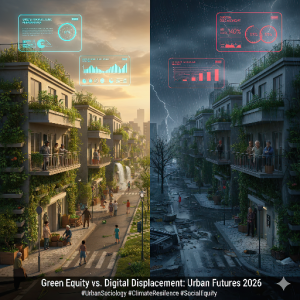
  • Digital Displacement: The rise of algorithmic short-term rental platforms and AI-driven gentrification models (which predict desirable neighborhoods) are accelerating the “Digital Displacement” of long-term residents. Sociologists are mapping these new patterns of “Automated Gentrification.”

  • Co-Living & Micro-Units: As a response, “Co-Living Spaces” and ultra-compact “Micro-Units” are becoming mainstream, particularly among younger generations. This trend is sparking sociological debate about the impact on privacy, community, and the definition of a “home.”

3. Climate-Resilient Urbanism: Adapting to Extreme Events

Cities are on the front lines of climate change, demanding rapid adaptation and innovative social responses.

  • Green Infrastructure & Social Equity: The push for “Green Infrastructure” (e.g., permeable pavements, urban forests, vertical farms) is gaining momentum. However, urban sociologists are highlighting the need for “Green Equity” – ensuring these benefits are distributed fairly across all neighborhoods, not just affluent ones.

  • Post-Disaster Social Capital: After extreme weather events, communities often exhibit remarkable “Social Capital” and self-organization. Studies in 2026 are focusing on how to systematically cultivate this resilience before disasters strike, integrating informal networks into formal emergency response plans.


Why Urban Trends Matter to Your Organization

  • Market Strategy: Understanding shifts in housing, transportation, and consumption patterns is crucial for product development and service delivery in dense urban centers.

  • Workforce Planning: Attracting and retaining talent in cities requires a deep understanding of urban livability, including affordability, public safety, and access to amenities.

  • ESG Compliance: Investing in sustainable urban development and addressing social inequalities in cities is increasingly vital for corporate social responsibility and stakeholder trust.