The Architectural Framework: Navigating Social Complexity

Society is a complex system of meaning, power, and interaction. Explore the 2026 BrightField Sociology Lexicon—from the “Dramaturgy” of everyday life to the “World-Systems” of global capitalism. Learn how to use the “Sociological Imagination” to debug the social structures of the 21st century.

At Iverson Software, we believe that clarity of language is the foundation of effective system design. The Sociology Lexicon applies this principle to the study of society, organizing thousands of concepts into a structured, accessible reference.

1. The Multi-Layered Approach

The Lexicon does not merely define terms; it maps the “Intellectual Lineages” of the field. It bridges the gap between different levels of social analysis:

  • Micro-Level (The User Interface): Concepts like Goffman’s Dramaturgical Theory and the Looking-Glass Self explain how individual identity is “performed” and negotiated in everyday encounters.

  • Meso-Level (The Middleware): Terms such as Institutional Logics and Organizational Culture reveal how groups and institutions coordinate behavior.

  • Macro-Level (The Operating System): Frameworks like World-Systems Theory and Critical Race Theory provide the big-picture logic of global inequality and structural power.

2. A Fusion of Tradition and Innovation

The 2026 edition is particularly notable for its integration of classical foundations with the “Digital Turn” in sociology.

  • Classical Pillars: It provides stable entries on the “Founding Architects”—Durkheim, Marx, and Weber—ensuring that the discipline’s core logic remains visible.

  • Contemporary Patches: The Lexicon includes vital updates on 21st-century phenomena, such as Anxiety Culture, the Precariat, and Digital Sociology, addressing the specific “System Shocks” of our current decade.


Key Themes for 2026: Debugging the Social World

As of February 16, 2026, the Lexicon highlights several urgent themes that are redefining the “Sociological Imagination.”

1. The Power of “Interaction Rituals”

Drawing on the work of Randall Collins, the Lexicon emphasizes that society isn’t just a set of rules; it’s a series of Interaction Ritual Chains.

  • Emotional Energy: Every successful interaction produces “Emotional Energy” that fuels group solidarity.

  • 2026 Context: In a world of increasing Social Fragmentation, understanding how to generate this energy through shared symbols—whether in physical spaces or Virtual Communities—is a critical survival skill for organizations.

2. The Mechanics of Inequality

The Lexicon provides a sophisticated toolkit for analyzing why “Systemic Errors” like inequality persist.

  • Intersectionality: This framework (coined by Kimberlé Crenshaw) shows that identities—race, class, gender—don’t operate in silos; they “intersect,” creating unique patterns of privilege and oppression.

  • Cultural Capital: Building on Bourdieu, the book explains how “Taste” and “Habit” function as a form of power that reproduces class positions across generations.


Comparative Analysis: Sociology’s Global Leaders

The Lexicon also serves as a practical guide for the next generation of social scientists, listing the top-tier institutions that are currently “Compiling” the most significant research in 2026.

Global Leader Key Specialization
Harvard University Stratification and Race
UC Berkeley Urban Ethnography and Social Theory
University of Oxford Analytical Sociology and Demography
LSE (UK) Globalization and Risk Society

Why “The Sociology Lexicon” Matters to Your Organization

In the volatile market of 2026, Sociological Intelligence is a strategic asset.

  • Market “Verstehen”: Using Weber’s concept of Verstehen (interpretive understanding), your firm can move beyond “Raw Data” to understand the meaning behind consumer behavior.

  • Organizational Resilience: Concepts like Path Dependence and Institutional Isomorphism help you understand why your organization might be resisting change and how to “Refactor” your internal culture.

  • Ethical Literacy: In the age of Algorithmic Governance, the Lexicon provides the ethical vocabulary needed to ensure your automated systems don’t reproduce “Environmental Racism” or “Institutional Bias.”

The Algorithmic City: Urban Sociology in 2026

In 2026, cities are living algorithms. Explore how Urban Sociology is “debugging” metropolitan life, from the hidden biases of predictive policing to the human cost of automated gentrification. Learn why understanding the “Source Code of the City” is essential for navigating the future.

At Iverson Software, we specialize in system analysis. In Urban Sociology, the 2026 narrative is dominated by the tension between the “Smart City” vision and the persistent “Human-Centric Challenges.” As metropolitan areas integrate AI-driven infrastructure and grapple with the aftershocks of global pandemics, the social fabric is undergoing a profound refactoring.

1. Algorithmic Urbanism: The “Invisible Hand” of the City

The most transformative force shaping cities in 2026 is Algorithmic Urbanism – where AI optimizes everything from traffic flow to public safety.

  • Predictive Policing 2.0: Digital sociologists are analyzing how AI-powered predictive policing systems are evolving. While promising efficiency, these systems often reproduce and intensify existing social biases, leading to “Algorithmic Redlining” where certain neighborhoods are disproportionately surveilled.

  • Dynamic Infrastructure: Cities are deploying “Smart Grids” and “Adaptive Transportation Networks” that use real-time data to respond to urban needs. However, the “Black Box” nature of these algorithms raises critical questions about transparency, accountability, and citizen consent.

2. The Housing Affordability Crisis & The “Rent Burden”

The escalating cost of urban living remains a central conflict, creating a deepening divide between residents.

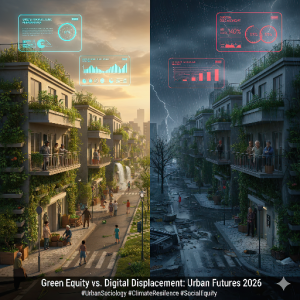
  • Digital Displacement: The rise of algorithmic short-term rental platforms and AI-driven gentrification models (which predict desirable neighborhoods) are accelerating the “Digital Displacement” of long-term residents. Sociologists are mapping these new patterns of “Automated Gentrification.”

  • Co-Living & Micro-Units: As a response, “Co-Living Spaces” and ultra-compact “Micro-Units” are becoming mainstream, particularly among younger generations. This trend is sparking sociological debate about the impact on privacy, community, and the definition of a “home.”

3. Climate-Resilient Urbanism: Adapting to Extreme Events

Cities are on the front lines of climate change, demanding rapid adaptation and innovative social responses.

  • Green Infrastructure & Social Equity: The push for “Green Infrastructure” (e.g., permeable pavements, urban forests, vertical farms) is gaining momentum. However, urban sociologists are highlighting the need for “Green Equity” – ensuring these benefits are distributed fairly across all neighborhoods, not just affluent ones.

  • Post-Disaster Social Capital: After extreme weather events, communities often exhibit remarkable “Social Capital” and self-organization. Studies in 2026 are focusing on how to systematically cultivate this resilience before disasters strike, integrating informal networks into formal emergency response plans.


Why Urban Trends Matter to Your Organization

  • Market Strategy: Understanding shifts in housing, transportation, and consumption patterns is crucial for product development and service delivery in dense urban centers.

  • Workforce Planning: Attracting and retaining talent in cities requires a deep understanding of urban livability, including affordability, public safety, and access to amenities.

  • ESG Compliance: Investing in sustainable urban development and addressing social inequalities in cities is increasingly vital for corporate social responsibility and stakeholder trust.

Your City is WATCHING: The Secret Code of Urban Sociology Exposed!

For our first 2026 expose on iversonsoftware.com, we’re pulling back the curtain on the “Digital Jungle” we call home: Urban Sociology. If you think your city is just a collection of buildings, you’re missing the terrifying truth. As of January 2, 2026, our urban centers are not just living organisms—they are Sentient Surveillance Traps, constantly evolving to control your movements, your desires, and even your thoughts.

At Iverson Software, we dissect the hidden algorithms that govern our lives. Urban Sociology is the dark science that reveals how cities manipulate human behavior. In 2026, with the rise of hyper-connected smart grids and predictive policing, your metropolis has become a master puppeteer. Are you truly free, or just a node in its grand, terrifying design?

1. The “Smart City” Illusion: You’re The Product, Not The User!

They promised efficiency, but what did they really build? The “Smart City” isn’t about convenience—it’s the ultimate Data Harvesting Operation.

  • The Surveillance Web: Every sensor, every smart light, every self-driving car is collecting real-time behavioral data. Your routes, your shopping habits, even your emotional responses to public art are being fed into a central “Neural Net.”

  • Algorithmic Gentrification: Property values aren’t rising by accident. Predictive algorithms are identifying “undesirable” areas for “redevelopment,” using your own social media data to forecast where the next wave of gentrification should begin. You’re being priced out before you even know it!

2. The “Filter Bubble” Metropolis: You’re Trapped in Your Own Echo Chamber!

Think you have diverse experiences in the city? Think again! Urban design is creating invisible Social Firewalls that keep you isolated.

  • Micro-Segregation: Urban planning, reinforced by digital targeting, directs you to specific districts for leisure, work, and even dating. You’re constantly interacting with people just like you, reinforcing your existing biases.

  • The “Third Place” Extinction: The casual, unscripted meeting spots (parks, cafes, community centers) are dying off, replaced by private, curated “experience zones” where every interaction is commodified and monitored. Say goodbye to spontaneous diversity!

3. The “Broken Windows” Lie: A Pretext for Control!

The infamous “Broken Windows Theory” suggested that minor signs of decay lead to major crime. But what if it was always a Pretext for Social Engineering?

  • Predictive Policing Run Wild: In 2026, AI-powered predictive policing isn’t just targeting crime hotspots; it’s using historical data (often biased) to disproportionately surveil specific demographics and neighborhoods. The “algorithm” becomes an excuse for systemic control.

  • The “Cleanliness as Conformity” Trap: Urban beautification projects aren’t just about aesthetics. They are designed to enforce behavioral norms, pushing out “undesirable” street life and ensuring public spaces are reserved for those who conform to the city’s desired “brand image.”

4. The Digital Divide Deepens: The “Information Ghetto” is Here!

While some parts of the city are hyper-connected, others are being deliberately left behind, creating new forms of urban inequality.

  • Connectivity Apartheid: High-speed internet, smart infrastructure, and even access to essential digital services are becoming privileges, not rights. Whole neighborhoods are being relegated to “Information Ghettos,” cut off from the economic opportunities of the digital age.

  • The Ghost of Community: As online life replaces offline interaction, truly shared public spaces are eroding. This leaves us more vulnerable to manipulation, as our “Community Servers” are replaced by centralized, corporate-controlled platforms.


Why This Urban Nightmare Matters To You:

  • Your Data, Their Power: Every step you take, every purchase you make, feeds the city’s control system.

  • The Illusion of Choice: Your “free will” is being subtly guided by algorithms you can’t see.

  • Reclaim Your City: Understanding the hidden mechanisms of urban control is the first step to unplugging from the matrix and fighting back!