
The Rural Refactor: Social Structures & Conflict in 2026

In 2026, the countryside is the “source code” for global stability. Explore how Rural Sociology is debugging the conflicts over water rights, the social impact of “Livestock AI,” and the rise of climate-driven migration hubs. Learn why the “Rural Burden” is the next big challenge for corporate social responsibility.

At Iverson Software, we analyze complex systems. In Rural Sociology, the 2026 update is about the friction between “Long-Standing Tradition” and “Rapid Digital Transformation.” As non-urban areas integrate AI-driven machinery and face intensifying climate pressures, the social fabric is being pulled in two directions: toward global efficiency and local resilience.

1. The Digital Agrarian Divide: AI and Social Power

The most visible shift in 2026 is the emergence of Precision-Powered Class Structures.

  • The “Data Engine” Farm: As rural operations evolve into powerful data engines, a new social hierarchy is forming. Large-scale growers with the capital to invest in autonomous tractors and “Livestock AI” are pulling ahead, while smaller operations face a steep adoption curve.

  • Technological Dispossession: Rural sociologists are tracking “Technological Dispossession”—where the high cost of smart equipment and software subscriptions forces smaller farmers into “Shadow Labor” roles or causes them to exit the industry entirely.

2. Natural Resource Conflicts: The War for Senior Water Rights

As weather patterns shift in early 2026, the management of natural resources is triggering local “Micro-Conflicts.”

  • Water Sovereignty: In arid regions like the American Southwest, “Senior Water Rights” have become the new currency of power. Conflicts are erupting between traditional agriculturalists, expanding suburban developers, and indigenous communities over who controls the dwindling “Blue Gold.”

  • The Energy Burden: Rural communities are increasingly at the center of the “Renewable Transition.” Sociologists are documenting local opposition to utility-scale solar and wind developments—a phenomenon known as the “Rural Burden,” where rural landscapes are utilized for urban energy needs.

3. Rural Resilience & The “Quiet Crisis”

Beyond the headlines, rural areas are facing a demographic reshuffling that is redefining community life.

  • The Silver Tsunami in the Fields: Rural populations are aging rapidly. Sociologists are studying the “Care Gap”—the lack of healthcare and financial support for older adults in isolated areas.

  • Climate Havens: Parts of the Upper Midwest and Pacific Northwest are becoming “Newly Attractive” hubs for agriculture and migration due to moderate climates. This is creating a “Demographic Boom” that strains local infrastructure while offering a rare chance for community revitalization.

4. Justice in the Heartland: Advocating for the Unseen

The 2026 Rural Sociological Society theme, “Advocating for Justice,” highlights the move toward legal and social equity in the countryside.

  • Beyond the Law: Sociologists are partnering with legal scholars to tackle “Law-and-Society” issues in rural areas—from immigration and land-use disputes to the “Opioid Empathy Gap.”

  • Food & Energy Justice: The focus has shifted to “Just Transitions,” ensuring that the move to a green economy doesn’t leave rural labor behind.


Why Rural Trends Matter to Your Organization

  • Supply Chain Integrity: Understanding rural social conflicts is key to predicting disruptions in food and resource availability.

  • ESG and Rural Impact: Organizations must ensure their sustainability initiatives (like carbon offsets or renewable projects) don’t impose a “Rural Burden” on local communities.

  • Emerging Markets: The “Climate Haven” shift creates new opportunities for localized services, rural broadband infrastructure, and diversified income models for younger farmers.
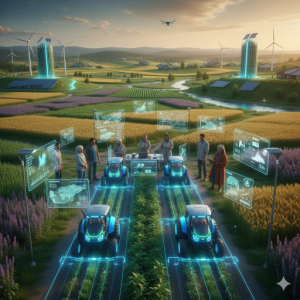
    The image provided for precision agriculture illustrates the integration of high-tech data collection and automation into modern farming.
    Sowing the Seeds of Data: Precision Agriculture in 2026

What’s New in Rural Sociology: 2025’s Most Surprising Shifts

Rural sociology is undergoing a quiet revolution. From digital infrastructure and health equity to youth employment and environmental justice, new research is challenging outdated narratives and redefining what it means to live—and thrive—in rural communities.

Rural sociology has long focused on farming communities, small towns, and the social dynamics of life outside urban centers. But in 2025, the field is expanding in bold new directions. Researchers are tackling issues like digital inequality, rural health gaps, youth employment, and climate resilience—all while challenging stereotypes about rural decline.

This isn’t just a shift in focus—it’s a redefinition of rural sociology itself. The latest work reveals that rural communities are far more diverse, dynamic, and globally connected than traditional models suggest.

1. Digital Infrastructure and Happiness

One of the most surprising findings comes from China, where researchers used a quasi‑experiment to show that digital infrastructure boosts happiness among rural residents. Access to broadband and mobile networks doesn’t just improve economic opportunity—it enhances emotional well‑being, social connection, and civic engagement.

This challenges the idea that rural areas are inherently disadvantaged. With the right tools, they can thrive.

2. Rural Health Equity and Clinical Trials

New studies highlight the urgent need to include rural patients in clinical trials, especially for conditions like cancer and hypertension. Researchers are developing community‑centered strategies to engage rural Black patients in the Southeastern U.S., emphasizing trust, access, and culturally responsive care.

This work is reshaping how public health systems think about equity, inclusion, and rural outreach.

3. Youth Employment and Regional Inequality

In Russia and Italy, sociologists are using center–periphery models to analyze youth employment and income inequality. These studies show that rural youth face systemic barriers to opportunity—but also that targeted interventions can reverse these trends.

The takeaway? Rural futures depend on policy, infrastructure, and education—not geography alone.

4. Environmental Justice and Agrarian Change

From Brazil to Bangladesh, rural sociologists are exploring how development discourses and land‑based livelihoods shape identity, power, and precarity. These studies reveal that rural communities are often at the front lines of environmental change—and that their voices are essential to sustainable policy.

5. New Books Reshaping the Field

Authors like Tim Slack, Lowry Nelson, and Kenneth P. Wilkinson are publishing landmark books that challenge urban‑centric narratives and offer fresh insights into rural complexity. Topics include demographic shifts, economic development, and the evolving role of small towns in national identity.

These works are redefining rural sociology as a field that’s not just reactive—but visionary.

Takeaway

Rural sociology in 2025 is bold, global, and deeply relevant. It’s no longer just about farms and families—it’s about infrastructure, justice, health, and the future of community itself.

Citation: BookAuthority. “3 New Rural Sociology Books Defining 2025.”