
The Rural Refactor: Social Structures & Conflict in 2026

In 2026, the countryside is the “source code” for global stability. Explore how Rural Sociology is debugging the conflicts over water rights, the social impact of “Livestock AI,” and the rise of climate-driven migration hubs. Learn why the “Rural Burden” is the next big challenge for corporate social responsibility.

At Iverson Software, we analyze complex systems. In Rural Sociology, the 2026 update is about the friction between “Long-Standing Tradition” and “Rapid Digital Transformation.” As non-urban areas integrate AI-driven machinery and face intensifying climate pressures, the social fabric is being pulled in two directions: toward global efficiency and local resilience.

1. The Digital Agrarian Divide: AI and Social Power

The most visible shift in 2026 is the emergence of Precision-Powered Class Structures.

  • The “Data Engine” Farm: As rural operations evolve into powerful data engines, a new social hierarchy is forming. Large-scale growers with the capital to invest in autonomous tractors and “Livestock AI” are pulling ahead, while smaller operations face a steep adoption curve.

  • Technological Dispossession: Rural sociologists are tracking “Technological Dispossession”—where the high cost of smart equipment and software subscriptions forces smaller farmers into “Shadow Labor” roles or causes them to exit the industry entirely.

2. Natural Resource Conflicts: The War for Senior Water Rights

As weather patterns shift in early 2026, the management of natural resources is triggering local “Micro-Conflicts.”

  • Water Sovereignty: In arid regions like the American Southwest, “Senior Water Rights” have become the new currency of power. Conflicts are erupting between traditional agriculturalists, expanding suburban developers, and indigenous communities over who controls the dwindling “Blue Gold.”

  • The Energy Burden: Rural communities are increasingly at the center of the “Renewable Transition.” Sociologists are documenting local opposition to utility-scale solar and wind developments—a phenomenon known as the “Rural Burden,” where rural landscapes are utilized for urban energy needs.

3. Rural Resilience & The “Quiet Crisis”

Beyond the headlines, rural areas are facing a demographic reshuffling that is redefining community life.

  • The Silver Tsunami in the Fields: Rural populations are aging rapidly. Sociologists are studying the “Care Gap”—the lack of healthcare and financial support for older adults in isolated areas.

  • Climate Havens: Parts of the Upper Midwest and Pacific Northwest are becoming “Newly Attractive” hubs for agriculture and migration due to moderate climates. This is creating a “Demographic Boom” that strains local infrastructure while offering a rare chance for community revitalization.

4. Justice in the Heartland: Advocating for the Unseen

The 2026 Rural Sociological Society theme, “Advocating for Justice,” highlights the move toward legal and social equity in the countryside.

  • Beyond the Law: Sociologists are partnering with legal scholars to tackle “Law-and-Society” issues in rural areas—from immigration and land-use disputes to the “Opioid Empathy Gap.”

  • Food & Energy Justice: The focus has shifted to “Just Transitions,” ensuring that the move to a green economy doesn’t leave rural labor behind.


Why Rural Trends Matter to Your Organization

  • Supply Chain Integrity: Understanding rural social conflicts is key to predicting disruptions in food and resource availability.

  • ESG and Rural Impact: Organizations must ensure their sustainability initiatives (like carbon offsets or renewable projects) don’t impose a “Rural Burden” on local communities.

  • Emerging Markets: The “Climate Haven” shift creates new opportunities for localized services, rural broadband infrastructure, and diversified income models for younger farmers.
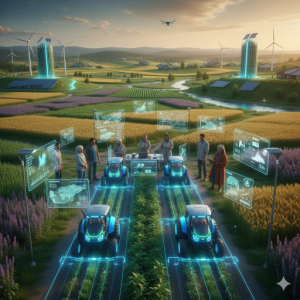
    The image provided for precision agriculture illustrates the integration of high-tech data collection and automation into modern farming.
    Sowing the Seeds of Data: Precision Agriculture in 2026

Planetary Feedback Loops: Societies, Environment, and Climate in 2026

In 2026, the planet is talking back. Explore how societies are “debugging” their relationship with the environment, from the urgency of climate migration to the wisdom of Indigenous knowledge. Learn why “Societal Resilience Audits” are now essential for every organization.

At Iverson Software, we specialize in system diagnostics. The relationship between human societies and their physical environment is, in 2026, a series of increasingly intense feedback loops. Our actions directly impact the planet, and the planet’s reactions are now directly impacting our social structures, economies, and very definitions of stability. This year’s focus is on “Societal Resilience Audits”—how well are we prepared for the inevitable, and how effectively can we adapt?

1. The Climate Migration Imperative: Shifting Populations

One of the most profound societal shifts of 2026 is the acceleration of Climate Migration.

  • Forced Displacement: Millions are being displaced by sea-level rise, desertification, and extreme weather events. Digital sociologists are mapping these “Climate Corridors,” observing the emergence of new social structures among displaced communities.

  • “Climate Havens” & Social Strain: The influx of climate migrants into historically stable regions (often in the Global North) is creating both opportunities for demographic revitalization and significant social and economic strain. New “Integration Protocols” are being developed to manage these population shifts.

2. Eco-Communities & Degrowth: Redefining “Progress”

A powerful counter-narrative to traditional industrial models is the rise of Eco-Communities and the philosophy of Degrowth.

  • The “Local Resilience Grid”: Around the world, communities are investing in hyper-local food systems, renewable micro-grids, and shared resource models. These are not just sustainable practices but a social statement, rejecting globalized consumption in favor of local self-sufficiency.

  • Degrowth as a Social Movement: The “Degrowth” movement, once fringe, is gaining academic and political traction. It posits that true sustainability requires a conscious reduction in resource consumption and a redefinition of “well-being” away from endless economic growth.

3. Indigenous Knowledge Integration: Ancient Wisdom, Modern Solutions

As Western science grapples with complex ecological crises, there is a profound resurgence of interest in Indigenous Knowledge Systems.

  • “Nature-Based Solutions”: Governments and NGOs are actively partnering with Indigenous communities to implement “Nature-Based Solutions” for reforestation, water management, and biodiversity preservation. These systems often offer more holistic and effective approaches than purely technological fixes.

  • Epistemic Reconciliation: This integration is more than just borrowing techniques; it’s a “Decolonization of Knowledge,” acknowledging that Indigenous worldviews offer crucial insights into living in reciprocal relationship with the Earth.

4. Carbon Capture & Geoengineering: The Technological Gamble

While social solutions gain traction, the allure of large-scale technological interventions persists.

  • Moral Hazard Debate: The rapid development of carbon capture technologies and nascent geoengineering proposals (like solar radiation management) presents a significant “Moral Hazard.” Sociologists are debating whether these technologies reduce the urgency for fundamental societal change.

  • Global Governance Challenge: The deployment of such technologies requires unprecedented global cooperation and raises critical questions about equity, accountability, and the potential for unintended environmental and social consequences.


Why this Relationship Matters to Your Organization

  • Risk Management: Understanding climate migration patterns and extreme weather impacts is crucial for supply chain resilience and strategic infrastructure planning.

  • Innovation Opportunities: The rise of eco-communities and degrowth principles creates new markets for sustainable products, circular economy models, and localized services.

  • Ethical Leadership: Integrating Indigenous knowledge and addressing environmental justice issues are becoming non-negotiable for brand reputation and stakeholder engagement.

The Great Rebalancing: Demography’s “New Era” in 2026

2026 is the year the “Population Pyramid” officially becomes an “Obelisk.” Explore how the Great Rebalancing is reshaping the world, from the “Silver Tsunami” in the West to the youth surge in Africa. Learn why migration is now the world’s most important “Economic Patch.”

At Iverson Software, we track data that defines the future. In Demography, 2026 is being hailed as the “Year of the Obelisk.” We are witnessing a fundamental structural change: the world’s population is not just aging; it is reconfiguring its geographic and economic foundations.

1. The Death of the “Generation Beta” Myth

Contrary to speculative reports in 2024 and 2025, demographic experts have confirmed as of late 2025 that we are not seeing the birth of a radical new “Kizazi Beta” (Beta Generation) with fundamentally different birth trends.

  • Stability Over Upheaval: Global birth rates have remained relatively stable across 2025. Instead of a new generational “boom,” demographers are focusing on the continued, steady decline in fertility across industrialized nations.

  • The “Replacement Gap”: Two-thirds of humanity now live in countries with fertility rates below the replacement level of 2.1 births per woman.

2. The “Cross-Over”: Deaths Outpacing Births

In many developed economies, 2026 marks a symbolic and statistical milestone: Natural Population Decline.

  • The UK Benchmark: For the first time in over a century (outside of pandemic anomalies), deaths in the UK are projected to exceed births by an ever-widening margin starting this year.

  • The “Silver Tsunami”: In the U.S., the oldest Baby Boomers turn 80 this year. This is triggering a massive shift in health care spending, housing markets, and labor supply.

3. Migration as the “Growth Engine”

Because natural growth (births minus deaths) is stalling in the West and East Asia, International Migration has become the primary driver of economic survival.

  • Labor Force Patching: By mid-2026, immigration will be the only reason the working-age population is growing in 52 countries, including the U.S., Canada, and Australia.

  • The Climate Displacement Factor: Climate-related events are increasingly shaping these migration patterns. 2026 is seeing a rise in “Internal Displacement” in resource-limited regions, placing immense pressure on urban infrastructure in sub-Saharan Africa.

4. The “Youth Surge” in Sub-Saharan Africa

While Europe and China shrink, Africa is the “Growth Hub” of 2026.

  • Fastest Growing Continent: Projections for 2026 confirm that sub-Saharan Africa will continue its massive rise, set to double its population by mid-century.

  • The Humanitarian Risk: Conflict and food insecurity in regions like Sudan, Mali, and Myanmar are creating the largest refugee crises demographers have recorded in decades. These areas account for 89% of global humanitarian needs in 2026.


Why Demography Matters to Your Organization

  • Workforce Planning: With a shrinking pool of young workers, companies must invest in Automation and Lifelong Learning to maintain productivity.

  • Market Adaptation: Seniors will account for one-quarter of global consumption by 2050. If your product isn’t designed for an aging user base, you are ignoring the fastest-growing market on Earth.

  • Strategic Geography: The centers of global labor and consumption are shifting toward the developing world. Prosperity in 2026 depends on understanding these new “Power Hubs.”